Physical comfort when you're breastfeeding includes thinking about chairs and cushions (especially in the early days)
Choosing the right breastfeeding chair and footstool
Chair arms on either side of you can interfere with your baby's positional stability during breastfeeding.
Your baby will tend to push away once her feet contact the chair arms, which risks breast tissue drag and positional instability during breastfeeds, causing fussy behaviour and difficulty coming on or staying on the breast. Resting your elbow and forearm on the chair arms may also position them at a height that worsens breast tissue drag.
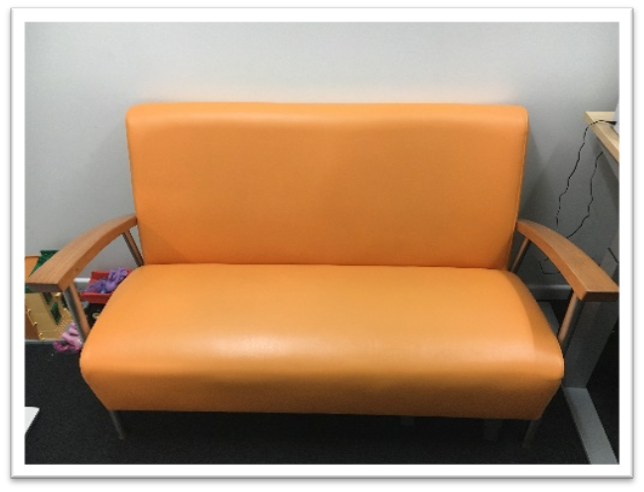
I suggest having a two-seater lounge chair available, with a separate footstool. You might purchase a cheap toddler step stool which your child will use, before you know it, for the toilet. Your footstool needs to be non-slip on the floor or carpet, and not too high - because we want to open up your lap, rather than have your heels on a similar level to your bottom.
“I was given a lounge-chair to use in the hospital,” women tell me, “that closed me and the baby in with its solid arms. Isn't that exactly what you're saying not to do?” I nod wryly.
“If chair arms interfere with breastfeeding, why are maternity suits fitted with these?” women ask, frustrated. I have no answer, except to say that our health systems don't yet understand the vital importance of supporting the biomechanics of breastfeeding.
You'll need some very firm pillows for elbow support when you're starting out with breastfeeding
Have a soft and squishy pillow or cushion ready to support the small of your back as you semi-recline into a deck-chair position.
And have a very firm small pillow available to support your elbow. This is because you are likely to find that you are holding your forearm out in the air, to position the baby without breast tissue drag, and without firm elbow support you'll quickly slip from the best position or develop pain.
Your baby's weight will fall into your body with gravity if you are semi-reclined, so that you don't have to carry the weight with your hands and arms. I always remove breastfeeding pillows from women's laps - with consent, after carefully asking if we could try experimenting with something different.
A pile of towels or a buckwheat pillow or a block used for yoga or even a banana-shaped 'breastfeeding' pillow folded in half can be placed under your elbow. The height required depends on the height that your elbow is at, once you've found the right position without breast tissue drag for feeding your baby.
A firm pillow is also necessary with side-lying breastfeeding, to support your back as you lie side-on at a tilt.
Your bed's mattress needs to be firm
Side-lying breastfeeding can help women get through the inevitable disrupted nights of those first months or even the first year of life. (If you are experiencing sleep problems such as excessive night-waking, I recommend you look at the Possums Baby and Toddler Sleep Program.)
Side-lying breastfeeding often doesn't work if you have a soft or sagging mattress, since breast tissue drag is more likely. More importantly, it isn't safe to share the bed with your baby if the mattress is soft or saggy. Make sure your mattress is firm, or experiment with using a yoga mat under the sheet to give you and the baby a firm surface on which to breastfeed.
-
You can find out how to share the bed with your baby as safely as possible here.
-
You can find out when it is not safe to share the bed with baby here.
The photo at the bottom of this page is an example of a two-seater lounge chair that is suitable for breastfeeding. This is the style I've chosen for various consulting rooms, after a long search for the right back height and slope, and chair depth. (It doesn't have to be orange to work, though.)