
When does a nipple shield help?
Nipple shields can help in three situations
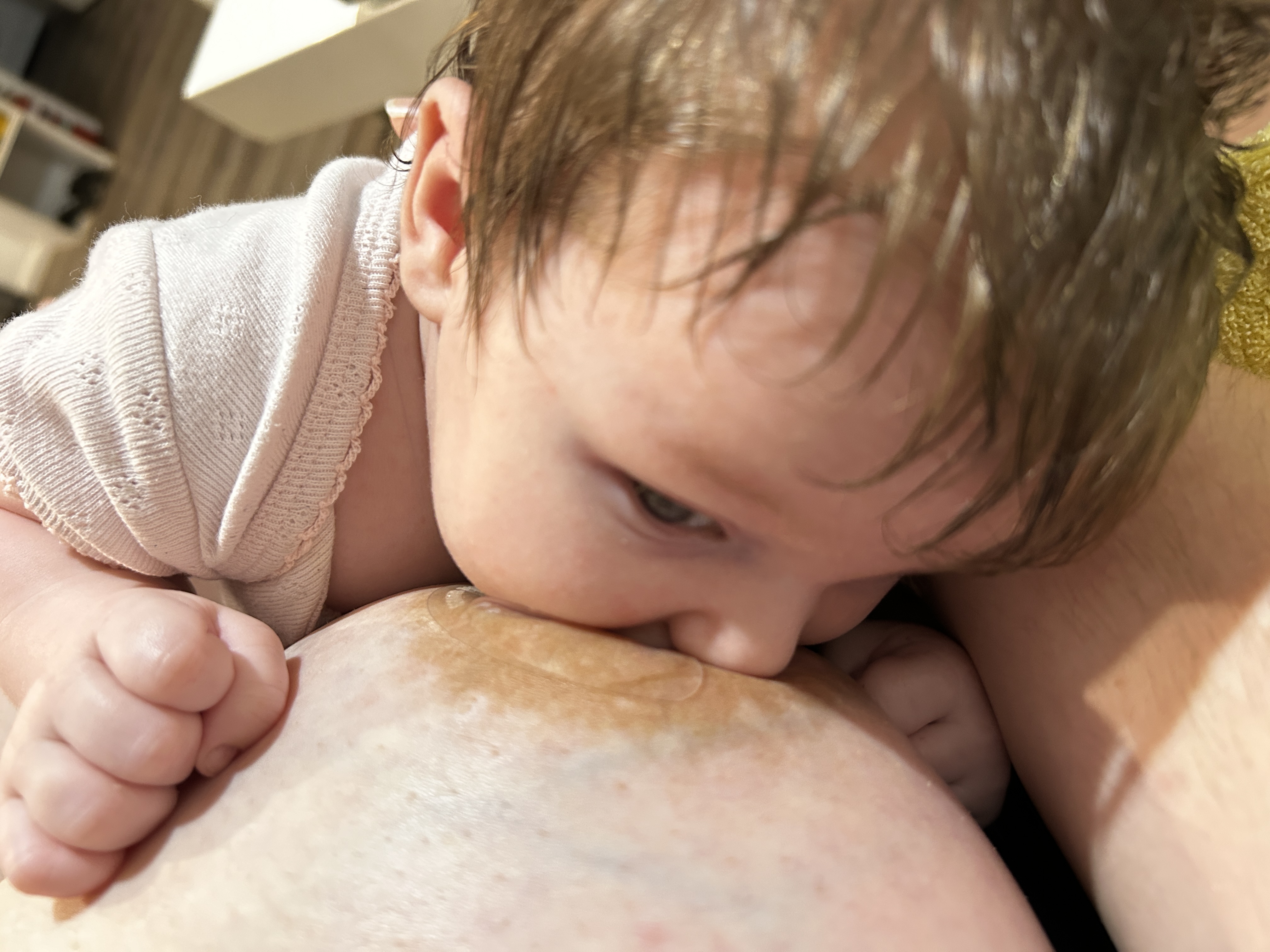
At the bottom of this article, you can find a discussion about why the nipple shield used by this woman and her baby in the photo above is most likely not helping their breastfeeding.
There are three situations in which I recommend nipple shields. Shields can help with
-
Minimising the pain from nipple inflammation and damage - while we put in place a gestalt approach to fit and hold
-
Conditioned dialling up at the breast when the little one is happily sucking from a bottle teat, but distressed with attempts to bring him on to the breast - at the same time as we put in place a gestalt approach to fit and hold
-
Genuinely low-height nipple even when the nipple is contracted, with difficulties bringing the baby on which haven’t quickly responded to the gestalt method.
The first two situations are often (though not always) preventable, and use of the nipple shield is part of repairing what's gone wrong, at the same time as we apply the gestalt method. In the third situation, the nipple shield use is an adjunct, a tool to put breastfeeding on a workable trajectory as quickly as we can, so that distressing experiences don't compound upon each other. In that latter case, once started, the nipple shield may need to be used long-term, though many women find over time that their baby works out how to come on without it.
It’s important to continue using the gestalt strategies as you breastfeed your baby with a nipple shield in place. Even without any use of the gestalt method, nipple shield use has been proven in the research to improve breastfeeding outcomes.
However, nipple shields are also dramatically overused as a compensation for our health system's failure to identify underlying problems of positional instability or conditioned dialing up at the breast.
1. Nipple shields can help you manage nipple pain and damage while you heal up, at the same time as you practice the gestalt method
The method of bringing baby on is different when using a shield: the cross-cradle hold is usually necessary, as you secure the shield in place with your fingers. (This is instead of switching on your baby’s breastfeeding reflexes by burying baby’s face into the upper part of your breast and using your forearm under his head to guide him down to the nipple as he bobs and searches around with his mouth.)
Then, as soon as the baby is on and you can let go of the shield, the same gestalt principles apply, and the presence of the shield can be ignored. You will still need to use micromovements, patiently tuning in to your own nipple sensations and to baby’s behaviours to find the most stable, pain-free place.
If there is pain and damage to the epidermis of the nipple, a soft silicone barrier can enable a woman to continue breastfeeding. But the same breast tissue drag that caused the problem in the first place will continue, and whilst the shield provides some protection, the nipple may not completely heal, or is re-injured each time you try without the shield. This is why applying the gestalt method even as you use a nipple shield is so important.
2. Nipple shields can help when a baby has a conditioned dialling up at the breast, at the same time as you practice the gestalt method
If your baby has become accustomed to taking milk from a bottle teat, and shows a conditioned dialling up at the breast, the nipple shield mimics the silicone bottle teat and can be a very helpful way for the baby to start remembering again just how lovely it is to be at the breast.
You can find out aconditioned dialling up at the breast and what to do here and here.
I explain to women that in a situation like this, the shield use is not a step backwards, but is often an effective tool which helps the return to direct breastfeeding. You may be able to stop the shield use down the track, though many women happily breastfeed indefinitely using the shield. Nipple shield use doesn't significantly change the amount of breast milk that a baby transfers.
3. Nipple shields can help with a nipple that is at the low end of the spectrum of height, at the same time as you practice the gestalt method
Sometimes, if a baby really does seem to be having trouble coming on to the breast and you wonder if the baby is having trouble coming on because your nipple doesn’t project very much above the areola, even with stimulation, a nipple shield can be an effective tool.
I suggest though that you try the gestalt approach first. Some women combine the gestalt method with using their hand to shape their breast into a ‘teat’ shape (without moving it much from where it wants to fall) then putting that arm under baby's head and moving into micromovements.
Nipple shields are often used to compensate for poor fit and hold but it's very important to still apply the gestalt method even when using them
How to use a nipple shield at the same time as you apply the gestalt method
The image below shows a woman breastfeeding using a nipple shield in combination with the gestalt method. You can see that when a shield is used with the gestalt approach, it is not possible for baby to slip off the shield or feed on the end of the shield - which you might wrongly hear are reasons to avoid nipple shield use!
How not to use a nipple shield
The mother and baby in the photo at the top of the page (also repeated below in full) are bravely using a nipple shield, presumably to help with either pain or a lot of fussing at the breast. However, now that you've got this far, you can see that there are multiple problems in this mother and baby's fit and hold which are likely to cause pain or fussing, and yet presumably the woman has been advised to use a shield, without any of the underlying problems being addressed. These problems include the way
-
The little one's lips are visible (that is, there baby is feeding from the nipple alone which typically creates nipple pain or fussiness at the breast).
-
The baby appears to be in a vertical position (often referred to as a laid back breastfeeding position, or biological nurturing, or koala position), which can often result in nipple and breast tissue drag as well. Turning on the baby's mammalian reflexes is important, but this specific adoptation of a more vertical or diagonal positon across the mother's body typically results in problems.
-
There is cloth under the mother's breast encroaching upon her breast's landing pad, which will interfere with a deep face-breast bury.
-
The mother or a helper is holding the baby's head in place. This can accidentally switch off the baby's breastfeeding reflexes, by limiting the baby's capacity to move independently.
-
Is this little one wrapped or swaddled? We can't see exactly, but the baby seems to be so far out from the mother's breast and torso that I wonder if she is wrapped - which will constrain her hands and her fit against her mother's body even further. You can find out about wrapping or swaddling your baby, why it doesn't necessary make baby more settled, and how to do it safely here and here.

Selected references
Chow S, Chow R, Popovic M, et al. The use of nipple shields: a review. Frontiers in Public Health 2015;3:doi:10.3389/fpubh.2015.00236.
Coentro VS, Perrella SL, Lai CT, et al. Nipple shield use does not impact sucking dynamics in breastfeeding infants of mothers with nipple pain. European Journal of Pediatrics 2021;180:1537-43.
Coentro VS, Perrella SL, Lai CT. Effect of nipple shield use on milk removal: a mechanistic study. BMC Pregnancy and Childbirth. 2020;20:516.
Geddes DT, Gridneva Z, Perrella SL, et al. 25 years of research in human lactation: from discovery to translation. Nutrients 2021;13:1307.