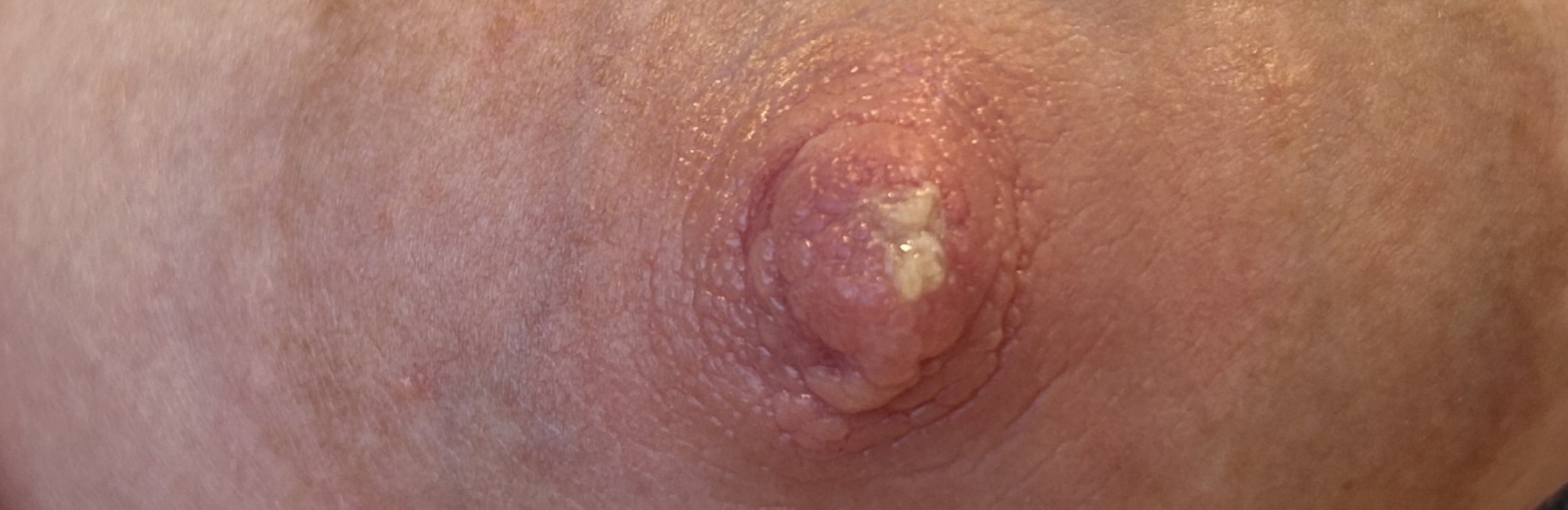
Case study: Manon has nipple damage from the first week of her baby's life
I first saw Manon 12 days after the birth of her firstborn baby Harry, who was born vaginally at term. Both Manon and her baby enjoy excellent health.
Manon has always offered Harry the breast frequently and flexibly, and his weight gain has never faltered. He has always been exclusively breast milk fed.
However, Manon has also always had pain with breastfeeding. In the first few days, when she told the obstetrician about how much pain she was experiencing, the obstetrician simply advised her to keep on going, saying the pain would pass. Manon was shaping her breast and using cross-cradle hold, the way she'd been shown in hospital, and most breastfeeds lasted an hour. By the fourth day she had large ulcers in the centre of each nipple, and circumferential cracks as well. These were worsening by the time she saw me on day 12.
She'd tried a nipple shield, but it didn't seem to help. It was amazing that this woman continued to directly breast feed her baby despite the amount of pain and damage she was experiencing.
When Manon saw me, I observed
-
Large amounts of nipple and breast tissue drag, due to a generous breast and landing pad compromise
-
Overhydration in the context of trying a range of moist wound healing methods
-
Approximately 4 x 5 mm shallow ulcers in the centre of each nipple, and cracks which were almost around the entire circumference of each nipple.
We discussed breast rest but she didn't want to use that option.
She began to heal when we worked with the gestalt method of fit and hold, using a rolled up cloth under her breasts; a nipple shield which I fitted and which was substantially larger than the shield she'd tried; and she protected her nipple from sticking to breast pads but also allowed as much air exposure as possible when she was home and at nights. I experimented with the silicon 'Breastfeeding Buddy' rolls that I'd purchased to try out in the clinic, instead of a rolled up cloth. But I was concerned that the silicon rolls interfered with the baby's comfort at the breast, pressing into his little body no matter how we tried to position them. We experimented with different 'Breastfeeding Buddy' sizes under the breast, but they interfered with fit and hold. The rolled up cloths worked best, because they held firm enough under breast, but had enough give where they protruded from under her breast to not interfere.
Manon had a bout of mastitis one week after seeing me, which we attributed to obstruction of the ducts due to external pressure. Her nipples were healing, but still ulcerated. The location of the inflammation seemed to fit with the way her baby like to apply pressure to her inner upper breast on that side with his little hand and fist. After 48 hours, her local GP prescribed antibiotics. I thought that was premature use of the antibiotics, but didn't say anything to Manon.
At seven weeks post-birth her damage was largely resolved, though the pain had never entirely gone away. However, in the last few days she had a freshened spot on her right nipple which presented like a white spot of hyperkeratosis. I've put a photo at the top of this article of the spot prior to breastfeeding, and an image of the spot post-breastfeeding.
We reviewed fit and hold and she said it was true that she'd been relaxing with this epecially during the nights, and believed that was why the damage freshened up. She'd stopped using the rolled up cloth to elevate the landing pad. I could see that there was ongoing nipple and breast tissue drag when she didn't use the rolled up cloth, due to difficulty getting the baby low enough.
Within ten days, going back to being very careful during breastfeeds, Manon had completely healed up and was painfree most feeds.